4 day snowshoe hike in Tux Alps, Austria
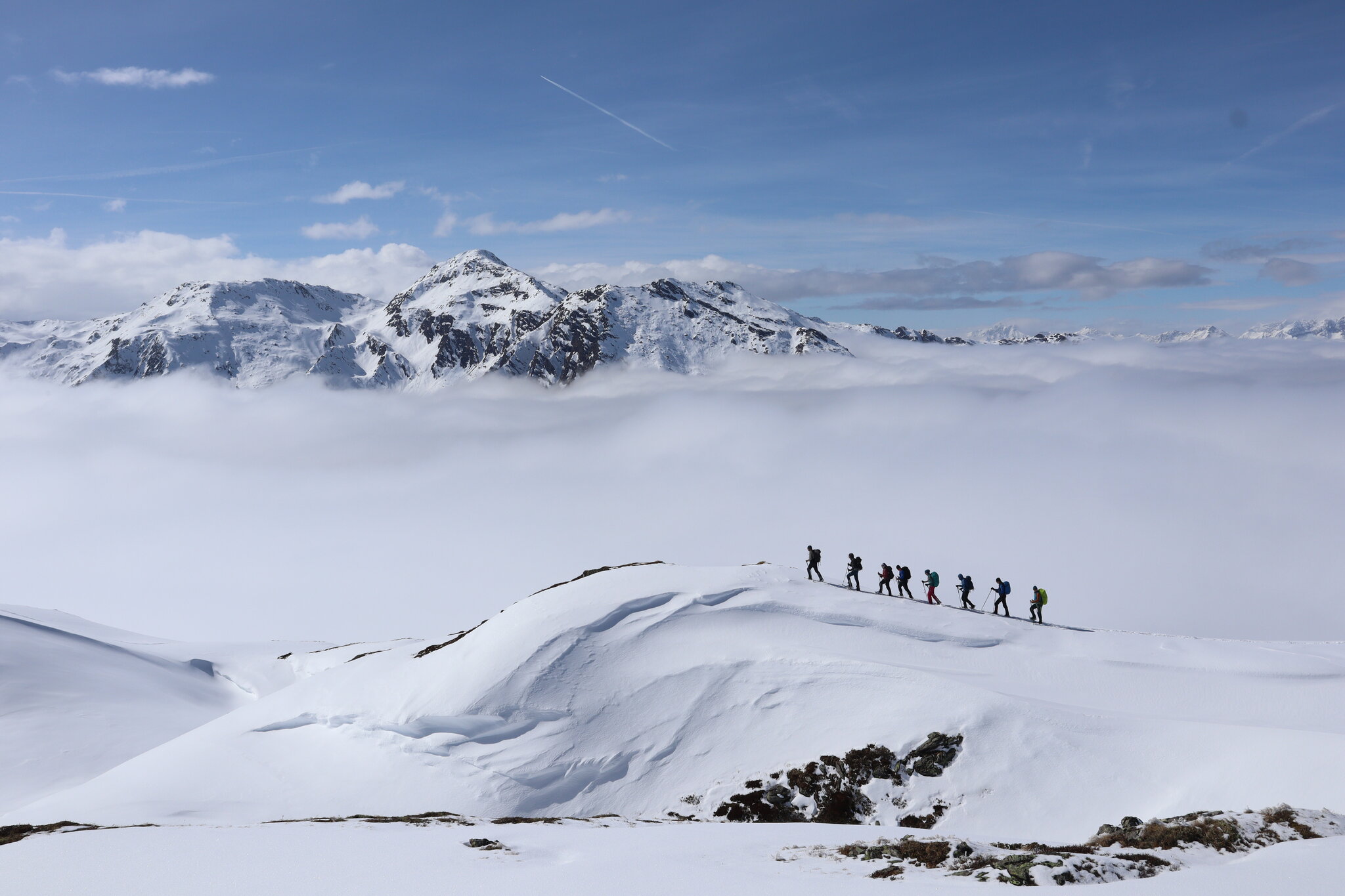
First time snowshoeing and accompanying as a ‘photographer’ and learned a bit about mountain adventuring with a group from the guide’s perspective.
Itinerary #
Date: 13-16 March 2026 Where: Weerberg Austria, Tux Alps Hut: Weidener Refuge
- Day 1: Basics of avalanche rescue, how to use snowshoe, avalanche beacons checks, using probes and shovel etc GPX track
- Day 2: Halslspitze 2574m GPX track
- Day 3: Nafingkopf 2454m, Hoher Kopf 2373m GPX track
- Day 4: Hubertusspitze 2205m GPX track
J asked if I wanted to join his guided group tour that he’s guiding to shoot some photos. It was a group of 4 girls from the Netherlands all around my age (around 30) and for most of them it was their first time snowshoeing and winter hiking.
Equipment #
Snowshoe hiking is one of the more accessible ways of winter hiking, because you don’t need skis and ski boots. I used my stiff summer boots and wore my summer hiking clothes + rented a snowshoe and that was enough. It’s good to have good hiking poles, and you will also need an avalanche set which you can rent out at the alpine club in Europe.
Snowshoes #
I learned there are different types of snowshoes out there.
I’ve only ever walked on Wakan (traditional japanese version of snowshoes) which didn’t exactly bring back great memories. For this trip, I tried out a Aluminum frame snowshoe with fixed binding which had an amazing float and I never had this much fun walking on snow!
If you’re curious about what Wakan is, here’s a comparison chart.

| Wakan (Traditional) | Snowshoes (Modern) | |
|---|---|---|
| Flotation | Low | High |
| Weight | Light, compact | Heavy, bulky |
| Slope performance | Excellent | Poor |
| Ease of use | Requires practice to attach; easy movement once on | Easy to attach; legs can interfere |
| Terrain fit | Narrow forests, technical ascents | Deep snow, flat/gentle terrain |
| Crampon compatible | Some models, yes | No |
| Price | ~€60 | ~€190–250 |
| Best for | Steep climbs, busy trails | Deep powder, remote areas, traverses |
Avalanche basics #
We didn’t plan to go anywhere above 30 degrees in steepness to keep the avalanche risk minimal (but never zero). Even though I’ve done some trainings in the past, it’s been a while since then and had forgotten a lot. What I found helpful is remembering the 4 elements:
The 4 Elements of an Avalanche #
- A Steep Slope (Terrain): Avalanches typically occur on slopes steeper than (usually to ), as this provides the gravity necessary for the snow to move.
- Snow Cover (Slab): There must be a cohesive layer of snow (a “slab”) sitting on top of a weaker, less cohesive layer.
- A Weak Layer (Instability): The weak layer acts as the lubricant or “collapsible” layer, allowing the top slab to slide. This layer is often formed by new snow, hoar frost, or faceted, sugary crystals.
- A Trigger (Initiation): A trigger is the extra weight required to fracture the weak layer. While this can be natural (e.g., intense snowfall, rain, or a cornice fall), in roughly 90% of cases, the trigger is the victim or a member of their party.
Source: The British Mountaineering Council
I also find this guide from Ortovox (sports brand) quite helpful.
Photos #


Thoughts #
Want to learn how to take photos in the snow, and in the mountains. Especially while moving. And learn more about avalanche safety and winter hiking.