How to project a climb
It’s been 2 years since I took my first Top Rope course at the local climbing gym here in Berlin and I’ve been climbing consistently since. Lately, I felt like I was plateau-ing in terms of the grades I was climbing so I signed up for a " Technik- und Taktiktraining. Planvolles projektieren einer Route" Technique and tactics training. Systematic projecting of a route.
- 2025/05/24, 25 (Sat, Sun) 11:00 - 15:00, 85 EUR
Day 1 #
Before the course, we were asked about our climbing level and what we wanted to work on. The instructor (let’s call him T) wanted to know what grade I usually could on-sight in a gym, RP(Red Point) after a few attempts and the hardest RP grade indoors.
For me, that was on-sight 6+, RP 7+, hardest RP 8- (indoors, UIAA). I had to think a while to come up with this, which just goes to show how ‘intentional’ I am with my climbing sessions.
There were 5 of us, we all sat down in a circle and discussed theory.
Leistungskomponenten Sportklettern (sport climbing performance components)
CategorySubcategoryElements****Technique (Technik) Movement PrinciplesEntkoppeln (isolation of movement), Präzises Treten (precise footwork), Nachgeben (yielding), Drüber & Rauf (up and over), Langer Arm (long arm), Weich greifen (soft grip), Statisch vs. Dynamisch (static vs. dynamic), Eingedreht vs. Frontal (twisted vs. frontal)Mental (Mentales) Fear & FocusSturzangst (fear of falling), Versagensangst (fear of failure), Fokus (focus), Erregungslevel (arousal control), Umgang mit Scheitern (dealing with failure)Mindset & Self-imageEntschlossenheit (determination), Biss/Wille (grit/will), Siegeshaltung (winning attitude), Mentale Gesundheit (mental health), Motivation, Selbstbild (self-image)Mental StrategiesRoutinen/Rituale (routines), Visualisierung (visualization), “Anker” finden/abrufen (mental anchors), Bewegungsabfolge merken (memorize movement), Probestürzen (practice falling)Social FactorsKletterpartner (climbing partner)Tactics (Taktik) Route StrategyAusbouldern (solving sections), Wiederholung & Variation (repetition), Clip-Positionen (clipping points), Ruhepositionen (rest spots), Griffe/Tritte markieren & putzen (mark/clean holds), Bewegungsabfolge merken (memorize sequence)EfficiencyPausen (rest), Länge der Abschnitte (section length), Pacing, Plan vs. Abweichung (plan vs. reality), Suchen vs. Abrufen (search vs. recall)PreparationDurchstiegsversuch (redpoint attempt), Äussere Bedingungen (external conditions), Regeneration & Ressourcenplanung (recovery/resource planning), Vorclippen (pre-clipping), Unterstützung durch Seilzug (pulley assist), Unterstützung organisieren (organize support), Chalken (chalk use), Atmung (breathing)Physical (Physisches) StrengthKraft (general), Maximalkraft (max strength), Schnellkraft (explosive strength), Kraftausdauer (strength endurance), Kraftentfaltungsrate (rate of force development)Other Physical SkillsAusdauer (aerobic endurance), Beweglichkeit (flexibility)
We then picked a route to project in the gym (a route that we were less than 50% confident that we will on-sight). On our first attempt, we took our time to figure out each move, stopping often to save energy and not to get pumped, re-doing moves and sequences by going down the wall a few times before reaching the top. We took 20 - 30 minutes, exploring one route. Taking longer rests and figuring out the best positions.
We then tried sending the route in one go (Durchstiegsversuch). The goal was to have memorised all the moves and sequences so that you’re not thinking or hesitating when climbing.
I found it difficult to memorise all the moves and holds on the first attempt, and ended up fumbling a lot in my first RP attempt (Durchstiegsversuch). Better luck on Day 2?
Day 2 #
We started the day at the bouldering hall. We picked a few ‘challenging routes’ where we climbed one route over and over until we had every move memorised. Then, we watched each other climb but before we went on the wall, we had to close our eyes, and explain while making the moves in the air how I would be climbing the route. (this was hard!) A few learnings:
- Articulating the moves made me more conscious of what I was doing on the wall
- Climbing over and over even after topping the route made me want to climb more efficiently (oh, I can skip this hold here, I can use my feet this way so I don’t need to step multiple times etc)
- Visualising really helped to make the move effortless to a point I didn’t have to think about the route at all. I can still remember each single move while I write this.
We then went back on the bigger wall with ropes and picked a route that was a bit challenging (a 8-) and tried the same thing as the day before. First two attempts to project, figure out the moves and memorise each move (15 mins x 2), then a RP attempt.
On my first try, I had to remember to consciously take breaks so I don’t get pumped. Figuring out the clipping position was also important. Re-do moves and sections over and over. That didn’t come naturally to me since until today, I’ve always tried on-sighting routes and when I’m not able to do them, I never re-did them again.
In my first RP attempt, I took once and managed to send the second time. What I liked about projecting was that I was moving more dynamically because I was more confident about each move and my feet placement became more precise. What felt impossible the first time felt much doable the last time, and that gave me confidence too.
One thing I noticed is that at my limit, I become a bit sloppy and less precise in my hand/feet placement. When people cheer me up and I get overexcited, I also become sloppy so I need to find a way to calm myself down in those situations.
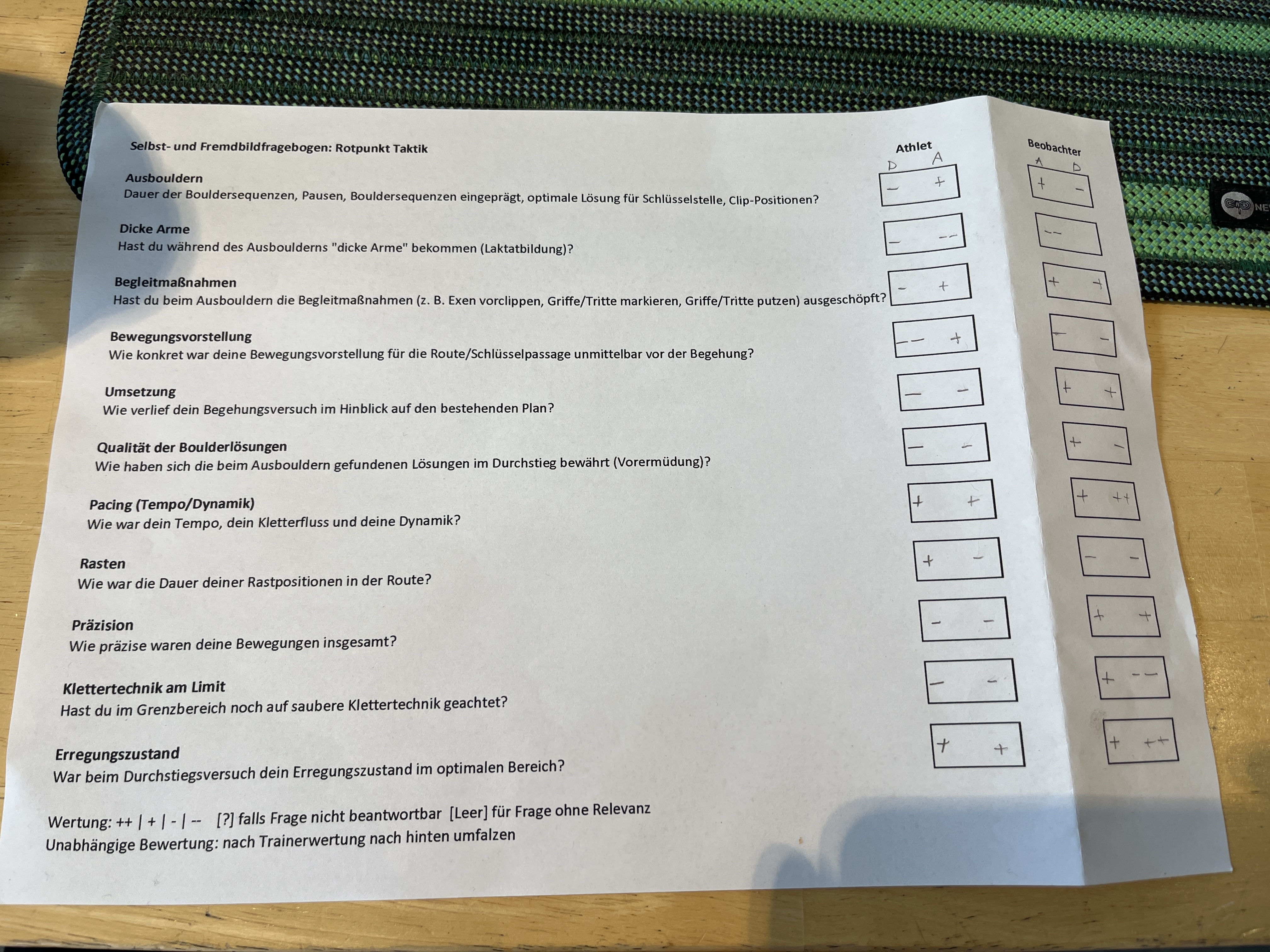
After each RP attempt, the climber and belayer both evaluated themselves and each other and compared our evaluations. That was quite interesting. Is my self-evaluation accurate? Am I evaluating others fairly?
Translation of the evaluation sheet
Bouldering Out
Duration of the bouldering sequences, pauses, sequences memorized, optimal solution for crux, clipping positions?
Pumped Arms
Did you get “pumped arms” (lactic acid buildup) while bouldering out?
Accompanying Measures
Did you make use of accompanying measures while bouldering out (e.g., pre-clipping quickdraws, marking holds/footholds, cleaning holds/footholds)?
Movement Visualization
How clearly did you visualize the movement for the route/crux just before the attempt?
Execution
How did the redpoint attempt go in terms of the existing plan?
Quality of Boulder Solutions
How well did the bouldering-out solutions prove themselves during the redpoint attempt (pre-fatigue)?
Pacing (Tempo/Dynamics)
How was your tempo, climbing flow, and dynamics?
Resting
How long were the resting positions during the route?
Precision
How precise were your movements overall?
Climbing Technique at the Limit
Did you pay attention to clean climbing technique in the limit range?
Arousal State
Was your arousal level in the optimal range during the redpoint attempt?
Final Thoughts #
I really struggled with my German but learned a lot about projecting and why I should do this more often!
Also, watched a few videos of top climbers incorporating visualisation to their training:
https://youtu.be/C_N8znD3exI?feature=shared&t=219
The End