Introductory Mountaineering Course in Innsbruck
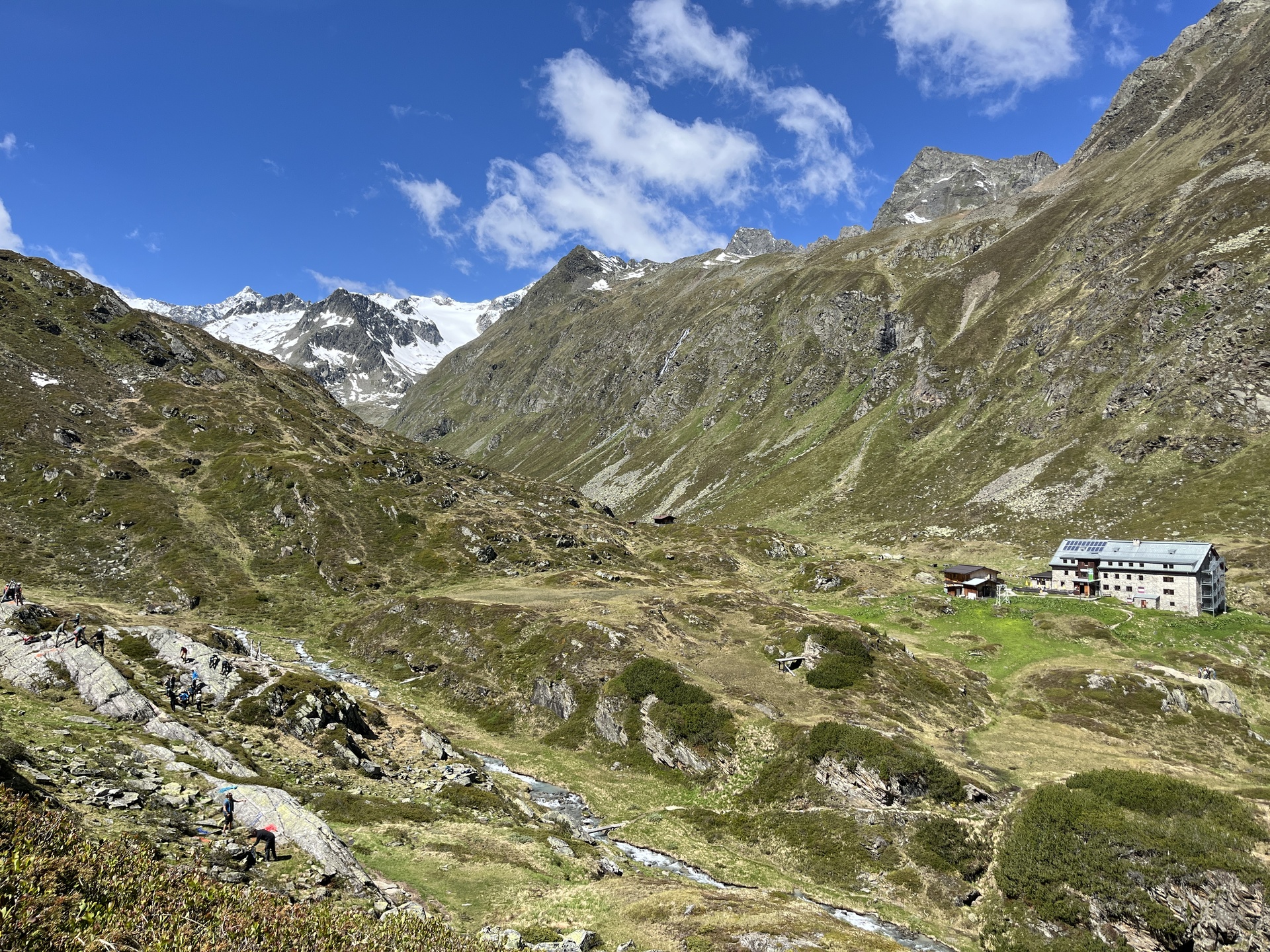
I’ve been wanting to do some basic alpine climbing courses and came across this one offered by the Austrian Alpine CLub (Österreichischer Alpenverein - Sektion Innsbruck) so decided to sign up. Usually you’d have to be part of the local alpine club to take the courses, but it turns out that you can get a guest membership as a OAV/DAV/SAC (alpine clubs from Austria, Germany and Switzerland) and you might get a spot (although local members are prioritized).
Alpine Mountaineering Basic Course (8–14 June 2026) #
The group was huge. 60 people that split into 6 teams with 2 instructors per team. I’ve never been in a group course this size before, and it was an interesting experience.
Part 1: Evening Sessions (Innsbruck) #
We met up at a local school, for some weekday sessions talking about equipment, knots and practicing the Seilrolle (Pulley Rescue) system over and over.
- Mon, 8 June (18:00–19:30): Clothing and alpine equipment overview.
- Tue, 9 June (18:00–20:00): Knots and rope exercises.
- Wed, 10 June (18:00–20:00): More knots and rope exercises, especially


Part 2: Practical Weekend (Franz Senn Hut, Stubai Alps) #
I managed to get a ride with some other people from the group (thanks G and M), and drove to Senduck which was about 40 mins drive from Innsbruck city center. From there, we hiked up about 700m (3h) to Franz Senn Hut.
Saturday Meet at 05:15, depart 05:30 from: Hausberger Elektrotechnik parking lot, Anton-Eder-Straße 21, Innsbruck. (Participants organize carpools themselves.) Second meeting point: Seduck, Oberbergtal. Hike (~3 hours) to Franz Senn Hut.

Rock-training activities near the hut - 9:30am Around the hut, the instructors split up and set up 6 different stations where each team/group had to go around. Each station was around an hour. I was exhausted from lack of sleep, I decided to skip 3 of the exercises and head to bed early.
- Abseiling (rappelling)
- Climbing
- Prusiking (ascending ropes)
- Team hauling systems: Pulley rescue / crevasse rescue techniques
- Via ferrata skills
- Movement in the mountains Overnight stay at Franz Senn Hut. (Great food!)
Sunday The next morning, I felt well enough to hike up with the group. We went up the Rope distribution and ascent in groups to Stiergschwez.
- Snow and glacier training (6am breakfast, 7am start)
- Falling and self-arrest on snow
- Glacier rope techniques
- Crevasse fall and rescue exercises (on snowfields, not on actual glacier)
- Return to Franz Senn Hut (around 13:00) and descend in small groups back to Seduck (15:30).
You can find the program and photos from last year here. This year’s version isn’t published yet.
Thoughts and what I learned #
Knots I Learned #
- Figure-Eight Knot (Achterknoten): The standard climbing knot used to tie yourself into the rope.
- Overhand Knot (Sackstich): A simple stopper knot used for backups and preventing rope ends from slipping through devices.
- Clove Hitch (Mastwurf): Quickly attach a rope to a carabiner. Fast, adjustable, and commonly used at anchors.
- Munter Hitch (Halbmastwurf): Belaying or lowering without a belay device. Useful as an emergency backup technique.
- Prusik Knot: The magic knot of glacier rescue! It slides when unloaded and grips the rope when weighted. Used for ascending ropes and building rescue systems.
Rescue Techniques #
- Mannschaftszug (Team Pull): The simplest crevasse rescue method. After securing the rope to an anchor, the whole team pulls together to haul the fallen climber out.
- Seilrolle (Pulley Rescue): A pulley-based hauling system that gives mechanical advantage, making it much easier to lift someone out of a crevasse. Often built using Prusik knots, carabiners, and pulleys.
I knew all the knots from sport climbing, but never realised how useful prusik was for a pully system like this. This was the main thing we did throughout the course, first trying it out indoors while using something stable as the anchor, then on a rock surface and then on a glacier using our pickle and a sling (Bandschlinge) to create an anchor from scratch. It was also quite hard to do the knots while being pulled down with someone’s weight, and with cold fingers + gloves.
I’m still unsure if I’ll be able to pull a partner up that’s way heavier than I am (but I guess that’s what the prusiking up is useful for so that the victim can pull themselves up).
Cost and other logistics #
People who participated were mainly in their 20s + 30s, mostly from around Innsbruck. Gender ratio being maybe 20% female which is a start I suppose and there were only one female instructor out of a dozen which made me sad. This whole experience made me want to do a girls only alpine trip, and to guide a group too.
Paid 120 EUR for the course + 90 EUR for the hut stay (half-pension, includes dinner, breakfast, lunch to pack and bed).
I wish I had been fitter on the first day to do all 6 stations (especially bummed that I missed the prusiking up) but next time I’ll try to sleep more the day before and hydrate better in general.
Gear #
- I borrowed J’s Rab Latok 38 Alpinrucksack but didn’t like it so much, maybe the wrong size or the lack of pockets I’m not used to, less supportive hip belt and it felt quite heavy even though I wasn’t carrying much.
- I saw a lot of instructors using Trad 30 Dry Rucksack or Trad 28 S Dry Rucksack from Ortovox which looked nice.
- Time for an upgrade?
- Hard shell (with breathable slits)
- Alpine trousers + hardshell (that opens on the sides)
- Sun glasses for snow protection
- Ice axe and crampons (which I don’t own)
- More locking carabiners (ball-lock)
A fun weekend.
All Images #


